The Stealth Tech Stack: How to Ace Live Coding Screens Under Extreme Pressure

We’ve all been there. You have years of solid production experience, but the moment you share your screen on Zoom during a live coding interview, your hands sweat and your brain freezes on a simple O(N) hash map lookup.
The tech hiring landscape has evolved. Companies are no longer just testing your coding skills; they are testing your cognitive threshold under artificial stress.
To survive, senior engineers are shifting their strategy from brute-force memorization to intelligent cognitive offloading.
1. The Core Solution: Cognitive Offloading
During a typical 45-minute live coding challenge, your brain is forced to multitask at an unsustainable level: parsing requirements, structuring algorithms in real-time, typing correct syntax, and explaining your time/space complexity out loud.
When your brain is overloaded, panic sets in. The key to breaking this cycle is offloading the mechanical task of syntax retrieval.
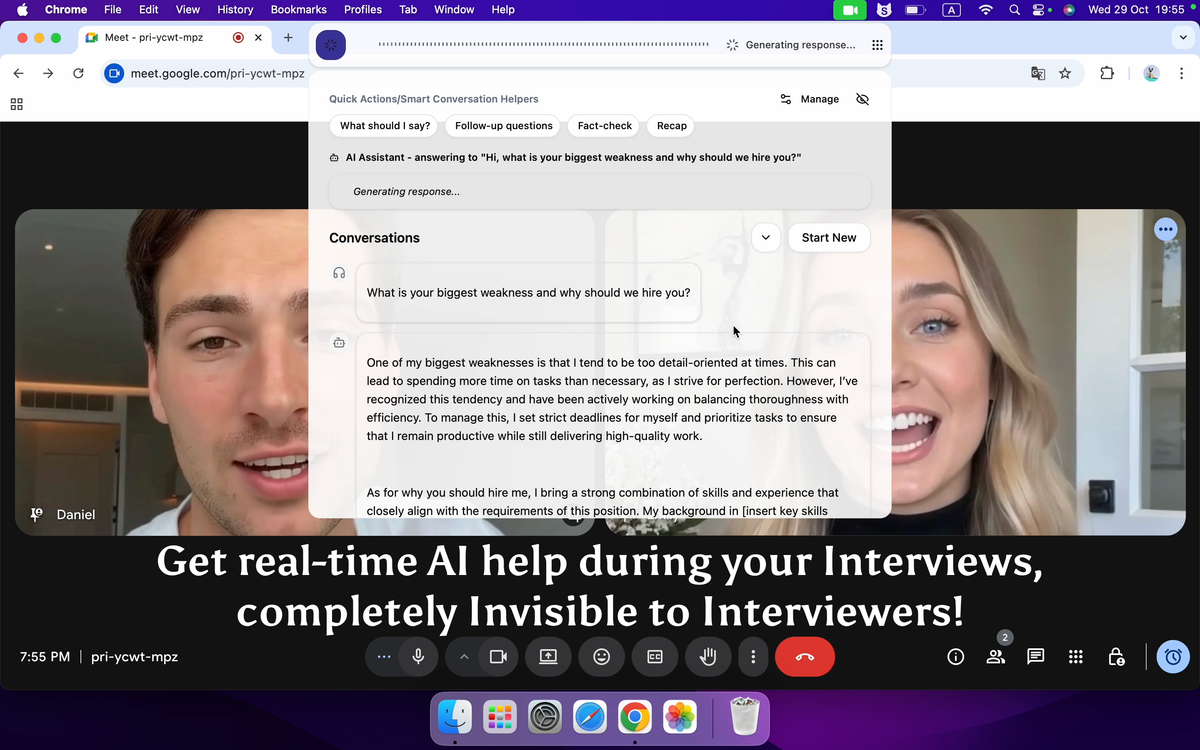
This is why many developers are now quietly integrating an undetectable AI interview assistant into their setups. By feeding the tool live screenshots of the coding prompt under the hood, you receive low-latency, real-time code suggestions on a secondary screen.
This serves as the ultimate anti-anxiety safety net, allowing you to focus 100% of your mental energy on driving the conversation and explaining system trade-offs.
2. Setting Up a Stealth Desktop Environment
To use assistive tools safely during a technical screen, your physical and digital setup must be completely bulletproof:
- Screen-Share Isolation: Never share your entire desktop. Only share the specific browser tab or local VS Code window containing your editor.
- Monitor Desynchronization: Run any auxiliary documentation or assistance tools on a separate virtual desktop or a dedicated secondary monitor positioned directly behind your webcam to keep your eye-line natural.
3. Master the Art of "Thinking Out Loud"
Once your mental safety net is configured, use these three steps to drive the interview:
- Clarify Constraints: Spend the first 5 minutes asking clarifying questions about edge cases.
- Draft Pseudo-code First: Write down the logical steps in plain English before writing actual code.
- Speak in Trade-offs: Explain why you chose one data structure over another (e.g., "We could use O(N²) time here, but we can optimize it to O(N) space-time using a hash map.").
Summary
Interviews are a performance. By setting up a secure, stealthy environment and utilizing real-time support, you can walk into your next technical screen with absolute confidence.
Good luck out there, and may the offers be in your favor!
